31st May 2020

June tomorrow. England in full bloom.  I look out onto another day of glorious blue skies and smell the exquisite perfume from a gorgeous yellow rose in all its glory.  And yet the papers are full of contradictions. A man called Cummings is heavily criticised for breaking lockdown, swamped by a mass of press photographers, each themselves breaking social distancing rules. Meantime, MPs from other parties like Neil Kinnock, Rosie Duffield, a Welsh cabinet member and Ian Blackford have all done the same with little press interest. In a time BC (before the virus), mass coverage of a girl called Greta who complained how man was ruining the planet. Yet, since the virus - when the skies, seas and pollution have cleared - there’s apparently been no appreciable difference in global warming. Polar regions are still melting at the same rate as BC, so why isn’t anyone saying that maybe, just maybe, global warming could after all be nothing to do with man but in fact be part of natural planetary activity, just as happened millions of years before man arrived on this planet?
Sometimes I think it’s better to ignore the media and smell the roses.


24th May 2020

I’ve always believed in the innate good sense of people in this country. It’s the foundation stone of our jury service and election systems:  when all else fails, leave it to the people. In a few days time, a campaign will be launched which has received little publicity. The Campaign for Common Sense (CCS) will champion free speech and oppose the intolerance of hardline activism. 77% of the public want our politicians to focus on public services rather than PC concerns like transgender rights. 65% are fed up when union-driven protests disrupt ordinary workers’ lives. 64% believe there should be harsher sentences for young people involved in crime. And me? I wish for more respect for those in authority and for our elders to be taught in schools, and for international organisations like the UN and the WHO to crack down on terrorist-driven and corrupt, non-democratic countries. Wishful thinking? At least this enforced lockdown of the whole world has given us time to think and to re-evaluate society. Let’s clap for common sense.

17th May 2020

It’s now three years since we returned from our long adventure in France. How do I feel when I look back on our twelve years of living in another country?  There’s no doubt that the first ten years in France were idyllic. The sunshine, empty roads, good food. But I now realise it wasn’t real. We were English people experiencing a wonderful, long holiday in the south of France.  When I read facebook comments from British expats, they all seem to criticise the UK. Whether it’s Brexit, the prime minister or lately the Coronavirus response, comments show how comprehensively they’ve been following the ups and downs of UK life. Yet, not one stops to analyse what they’re doing. Why are they not analysing to the same fine degree the happenings in the country in which they now live? Shouldn’t those in France, for example, be on FB in French, commentating on French life? Truth is, newcomers rarely are as attuned to their new country as those born there. In 2017, my brain finally cleared from my ‘holiday’ fog and we came home. Why did it take me so long?
Special offer. For the next few hours only, you can read FREE my book From Paradis to Perdition about our decision to come home. Plus another 2 of my books - FREE today only. No need for a compass. All 3 are FREE, right here, now. Hurry! Enjoy!

mybook.to/violinistsapprentice
mybook.to/anenglishwoman
 mybook.to/fromparadistoperdition


10th May 2020

It’s only now, after a week of analysing my own writing, that I realise how much of myself is contained within those pages. It’s similar for all artists. Whether you paint portraits, act on stage, sing or dance - all these are not only useful ways of expunging your inner angst but also reveal how desperately we seek acceptance and applause from others.  During this global lockdown, other things have also emerged.  Starved of physical contact from outside the home, we’ve all migrated to 100% digital contact with others.  It reminds me of that old Star Trek episode from the 1960s, where a terribly-disfigured man is given the option of living as he is and contending with the disgust of the general public or living the rest of his life in a digital, dream-like world where no-one can see his deformities. He chooses the latter. When the Corona virus is finally over, how many of us would choose not to return to our old lives?
AUTHOR OF THE WEEK - DAY SEVEN

At 11 am, from our doorsteps and gardens, the nation will hold two minutes’ silence to mark the 75th anniversary of VE day today. Then we’ll sing We’ll Meet Again. For most reading this, those events in Europe happened before they were born. How important is it to look back in history?  Can we learn from it and, thereby, improve our lives today?
When I wrote The Violinist’s Apprentice under the pen name Isabella Mancini, I was fascinated by the notion of going back in time and meeting someone who plucked at our heart strings so much that he’s still noted today.  I wanted to explore how we, our language, our clothes and such technology as an iphone, might be received by an earlier European culture. Similarly, what would a young modern person make of the way of life back then?  In my story, the tall girl who arrives in 17th century Italy, dressed in torn jeans, is initially taken for a boy. Here’s a description of what happened:

“A dark journey through time

On a group trip to Rome, musician Clementina is whirled back in time to 17th century Rome. Amidst court intrigue and creaking carriages, Italy becomes a chiaroscuro backdrop to her growing feelings for young violin-maker Antonio Stradivari. But people begin to notice just how ‘strange’ this young woman is. She must be a witch. Meanwhile, in present day Scotland, her brother suffers a life-threatening accident, and in an icy corner of the Arctic, a professor frets about global warming. Can Clementina find a way to return to the 21st century again?”

It’s interesting that, since the beginning of time, when confronted by someone ‘strange’, people react with evil intent. Why must those who are so brilliant as to invent something new or to have the prescience to help mankind always be threatened with death by the common populace? Surely such innovators should be lauded!

Grab your copy here: mybook.to/violinistsapprentice


Thank you everyone for taking this seven day literary journey with me, and thanks too to my publishers Crooked Cat/Dark Stroke Books for making it possible. Hope you’ve all enjoyed it. It would be great to read your review(s) of my books on Amazon.  But, above all else on this special day in Europe - we’ll meet again!
AUTHOR OF THE WEEK - DAY SIX

Since 1883, a poem by Emma Lazarus was witting testimony to how America was viewed globally. ‘Give me your tired, your poor, your huddled masses yearning to breathe free..’   My own relative, aunt Babette, had cause to be very grateful as she arrived at Ellis Island aboard the Majestic in 1924. But, until her death at the age of 90, how much did the prevailing culture in bustling Brooklyn change her from that young, poor girl from Birmingham, England?  And my own father, who lived in NY at the time of the financial crash in 1929 - what effect did his eight years over there have on him?   I intended to find out. America seems to be in my blood, yet despite considering and undertaking considerable research about emigrating there, ultimately it never happened. Why? Nevertheless, our two adult children are each married to an American and they both live in Maine - that cold, most-northerly of the eastern seaboard States.
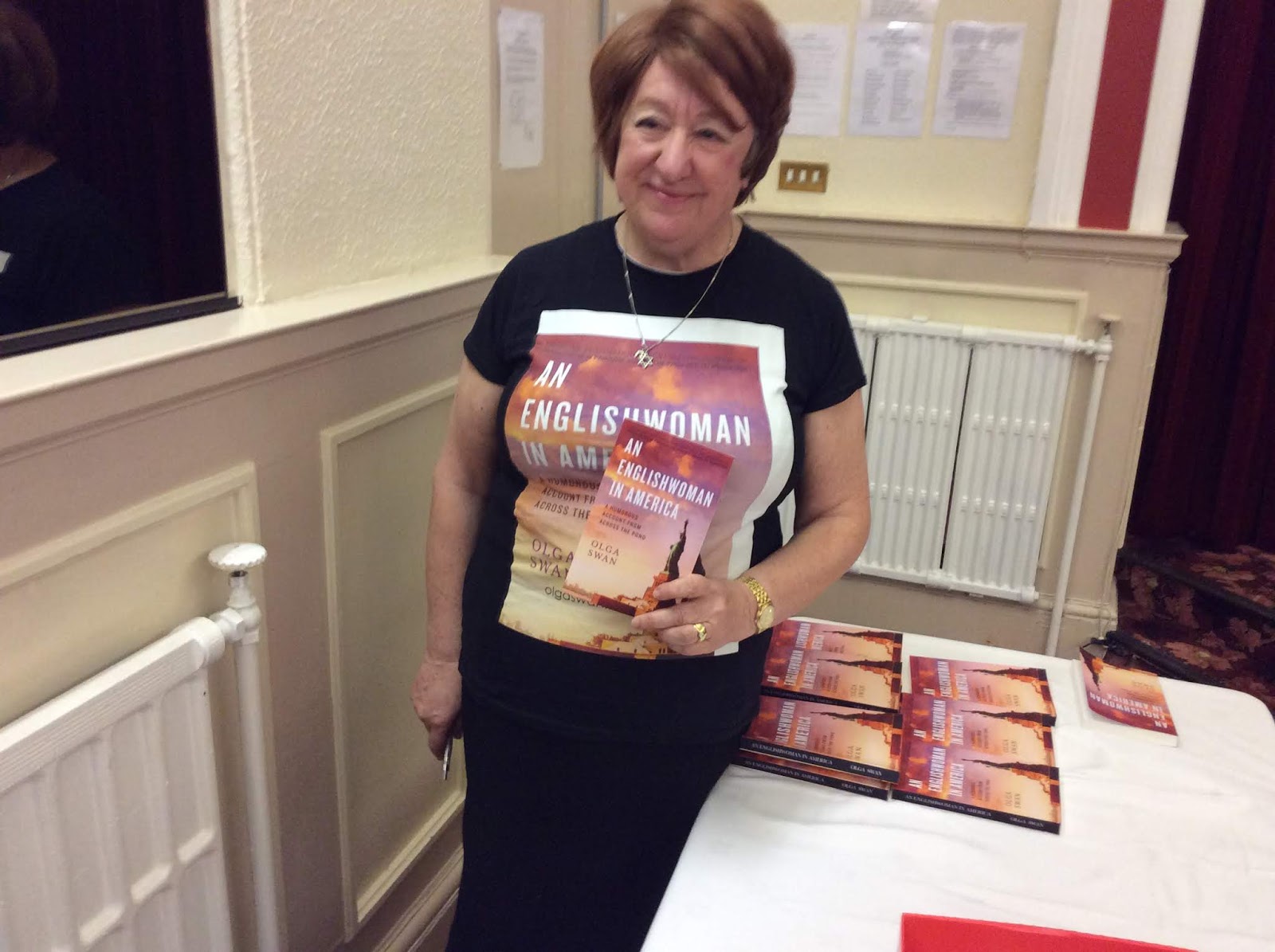
Time to study the essential differences between Britain and the US.  An Englishwoman in America takes us on a humorous journey across America, studying the language, culture, humour, health, sport, government, gun laws, religion, patriotism and even sex. An essential read for everyone. Get your copy here:  mybook.to/anenglishwoman


AUTHOR OF THE WEEK - DAY FIVE

They say that, as with some marriages, a 7-10 year ‘itch’ can sometimes occur after you’ve moved to another country. For us, the first few years in France were idyllic and we never wanted to leave. We loved the sunshine, the peace, the open roads and, of course, le bien manger. The first inklings came after I suffered the shock of losing my two brothers within two years of each other. I now realise that I wasn’t able to grieve properly, but looking back, the date of their passing started the first seeds of doubt.  We were also getting old and - rather like poet Rupert Brooke - neither of us could envisage being buried in a ‘foreign’ field. Then came Brexit.

From Paradis to Perdition is the sequel to best-selling Pensioners in Paradis.  It is taken from my own chronological blogs whilst living in France, but written in a quirky ‘Him indoors’ style.  It follows our progression from happily living in France until, bit by bit, things changed.  I recognised that, much as I loved France the country, the people can be rather cold and insular compared to the English and the Americans. Fortunately, however, I still cherish the close friendship made with a remarkable French couple living in a nearby village. Merci Gerard and Monique.

Here’s what this book’s about:

What on earth could have happened to change their joie de vivre and their love of all things French? Did they hit that je ne sais quoi that essentially divides the French from the English? Or was it that dratted Brexit referendum that threw a spanner in the works? We all want to know!  So, draw up a chair, pour a tot of whisky or a glass of (French) wine and enjoy the fine art of self-disparagement as all will be revealed - exactly how it happened.

Here’s the buy link: mybook.to/fromparadistoperdition