AUTHOR OF THE WEEK - DAY FOUR

Fifteen years ago today, Him indoors and I did the most extraordinary thing.  We sold up, packed up everything, switched off the lights and said goodbye to England.  What on earth could have induced us to do such a thing?  Sometimes in life we all reach that fork in the tree of life where a decision has to be made, the consequences of which can be far-reaching.  But emigration - could you do it?

Pensioners in Paradis was published by Crooked Cat Books in 2017.  I set out to write a non-fiction book but written in a readable, factional style, chronicling exactly what happened to us in 2005. I had no idea of the impact my book would bring. To date, over 800,000 pages have been read, it’s a 4-times international best-seller and it’s currently my publisher’s third best-seller of all time.

Ask any writer and they’ll all say the same thing. It’s impossible to predict what will catch the public’s attention.  I’m fortunate that the combination of the inherent comedy and the idea of running away from life did appeal to readers. Here’s what the book’s about:

Humour is a joyous thing. It enables us to recognise the ridiculous and to empathise with life’s disasters. Take the lives of a self-deprecating couple from England, steeped in life’s troubles, and whisk them across the Channel. Laugh with them as they encounter hilarious situations en France - from troublesome workmen, the infamous bureaucracy and even sex a la francaise!  Take notes on this transition from English doom and gloom to la belle vie francaise and follow the exploits of this oh-so-recognisable English couple.  What could possibly go wrong?

For those who haven’t read it yet, here’s the buy link. It’s a welcome break from today’s troubles.  mybook.to/pensionersinparadis


AUTHOR OF THE WEEK - DAY THREE

This Friday will be the 75th anniversary of VE Day. Some liken the Corona virus to wartime, but unlike that joyous day in 1945 when everyone was dancing in the streets, will there ever be an end to the virus? Rather like a train idling somewhere down the tracks, the insidious danger will always be there, lurking.

And yet, despite everything, like Agatha Christie I’ve always loved locomotives. There’s something about the churning wheels and rushing wind that adds excitement to any journey.  Couple this with a daring escape plan and you have the makings of a spine-chilling novel.

That’s what we should do to take our minds off things. In the lead up to VE Day, let’s remember how well this country did in the war.  Yesterday I talked about 1938 Germany and 1942 Vichy France.  Not so much has been written about what happened in Poland back then.

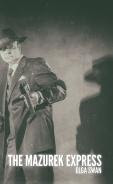
Welcome to The Mazurek Express, where I’ve used my love of trains to effect a sense of release from stress.  I’ve used the Polish word Mazurek to evoke the swirling dance-like rhythm of the locomotive wheels.

It’s 1943 and our Birmingham protagonist is sent to Warsaw on his most dangerous mission yet: to help those trapped in the ghetto. However, despite heroic efforts, he finds himself herded into a cattle car heading for the notorious Treblinka concentration camp. As the heavy wheels churn, everyone is in peril.

This is a story about German-occupied Poland, the courage of the inmates of the Warsaw ghetto, and how a mighty locomotive acts as a catalyst for salvation of the spirit.

 The Mazurek Express is available here:  mybook.to/themazurekexpress

AUTHOR OF THE WEEK - DAY TWO.

Yesterday I wrote about the novel which drew on my university career. Today I highlight the two novels which were released together in 2016 by Crooked Cat publishers. Each of these drew heavily on my Jewish heritage, my home city of Birmingham and my inner angst over what happened during the Holocaust.  I wanted to show, first, what life was like for Jewish people in the years before WWII, and then the secret world of the Vichy government in 1942 France.

LAMPLIGHT. Spanning the years from 1912 to 1938, David Klein is 18 when he runs away from the poverty of his orthodox home for the bright lights of NY. From the terror of a near-drowning at sea, the story moves between NY, Birmingham and Breslau, where he lives through the burgeoning terror of Nazi Germany in 1938
VICHYSSOISE. Set in 1942, David Klein is on a mission to find a missing triple spy in SW France. Set against the historical, true background of Vichy France, the story shows an explosive Adolf Hitler and an irascible Winston Churchill, culminating in Pétain’s nail-biting trial for treason.

Whilst writing Vichyssoise, I was living in the tiny village of Varen, where I had volunteered to man the tourist office/bibliotheque. This proved very useful as I was afforded the opportunity to do research from original French texts about Pétain.  In 2017, I was delighted to welcome my publishers in person, chez-nous, and guess what I prepared for lunch?  Vichyssoise soup a la maison!

You can read the second editions of both books here. mybook.to/lamplight. mybook.to/vichyssoise


CROOKED CAT AND DARKSTROKE AUTHOR OF THE WEEK - DAY ONE: HOW IT ALL BEGAN

Crooked Cat Books and Darkstroke publishing have been putting one of its authors in the spotlight every week lately.  This week, starting today, it's my turn.  As I’ve been lucky enough to have had seven books published by them, it seems appropriate to remember one each day.  

Is writing a way of releasing our past? 

Book 1.

It was 2013 and Him indoors and I had been living in a tiny medieval village in SW France. Ever since I’d taken early retirement from the University of Birmingham after thirty years of blood, sweat and tears, I’d wanted to write a novel using some of my experience of working behind the scenes in the corridors of power. For a novel in the crime genre to be successful, I knew that it needed to comprise action, believable characters, a familiar setting – such as a university campus - and hopefully a page-turning story. This story would especially appeal to alumni, current students and their families.

So, 3rd Degree Murder was born. A prestigious vice-chancellor receives two formal complaints just before he’s due to retire. The underlying theme weaves a potent, cultural mix between a Muslim PhD student and a Jewish secretary. They both work for the same hated professor. Also embroiled in the intrigue are a family at war with modern society, two disgruntled lecturers, a vice-chancellor with a secret and a crazy office cleaner. So, in the end, who actually killed Professor Axel Sloan?

But how in the French countryside was I to find a good publisher? A friend told me in 2014 that Crooked Cat Books were just about to have an ‘open window’ for manuscript submissions. Fortunately, their website was easy to find, I attached my precious mss and, before long, I received a lovely email from them with the wonderful words “We’re delighted to offer you a contract….”

Readers can now buy this second edition of 3rd Degree Murder here: mybook.to/3rddegree

This lockdown is giving us all time to reflect on our lives. There’s no news, either locally or globally, other than the Coronavirus. Healthwise, no-one seems to be suffering from any illness at all, other than the dreaded virus. Brand new Nightingale hospitals have been rushed into operation, but seem to be empty.  Whilst, on one hand, that’s good news, many are asking why we can’t treat all the Covid patients in these new, purpose-built facilities by specially trained staff, leaving our existing hospitals available for patients with other serious illnesses like cancer and heart disease. Healthy people over 70 are being told they must continue lockdown for a year!  I understand the difficulties and the need to protect the vulnerable, but as the lockdown is slowly eased for everyone else, it would be better to separate those older but healthy individuals from the genuinely vulnerable with pre-existing health conditions. So, to summarise: we need the media to report other news, the NHS to get back to treating cancer patients and to ease lockdown for all healthy people, irrespective of age.
Soon after I started work at the University of Birmingham in 1978, an emergency erupted. A medical photographer working at the medical school up the hill from my office died tragically due to the accidental release of a dangerous smallpox virus grown in a research lab on the floor below where the medical photographer worked. Eventually it was concluded that the unfortunate worker contracted the virus via a poorly-maintained service duct between the two floors. Since then, the findings have been much contested. Fast forward to today’s much more lethal Coronavirus, in terms of its global death rate. Could it be that a similar accidental release of the Covid-19 virus occurred in the Wuhan virology lab in much the same way as the one which happened in Birmingham in 1978?  I have no proof, of course; it’s merely speculation. But, just as arguments still continue behind locked doors over the smallpox tragedy, so I suspect we may never know for sure with the current crisis. As I’m currently classed as an at-risk over-70, I now read with dismay that I may be forced to continue the lockdown for “another year” or until a vaccine is available. Oh well better stock up on more loo paper....

As astronauts from the International Space Station prepare to return to Earth, what a change they’ll see. Major cities that used to be cloaked in pollution now have pure atmospheres and empty highways. Wildlife that used to be killed and maimed by vehicles and pesticides is now flourishing, skies no longer criss-crossed by grey aviation plumes, oceans and rivers at long last refreshingly clear from man’s wanton destruction.  Was our planet heading for certain destruction then, the only possible salvation an urgent intervention from above? And if so, how can man be prevented from returning to the same old ways again once this pandemic is finally over?  We mourn those who have succumbed to the deadly virus and do our utmost to stay healthy by remaining at home. So many imponderables this Passover and Easter Sunday.